
Beverage production depends on relationships among assets, recipes, process parameters, packaging formats, quality checks, maintenance history, and production schedules. These relationships are often distributed across programmable logic controller (PLC) tags, supervisory control and data acquisition (SCADA) systems, manufacturing execution systems (MES), enterprise resource planning (ERP) platforms, computerized maintenance management systems (CMMS), historian databases, equipment manuals, and operator procedures.
Industrial Knowledge, Learning, and Deployment Research for Beverage Production
Industrial Artificial Intelligence must remain useful as beverage equipment, production data, product formats, and operating conditions change. A model that performs well on one filling line or at one facility may behave differently after a line changeover, sensor replacement, recipe revision, maintenance intervention, or deployment at another plant. BeveragePro examines research approaches for organizing industrial knowledge, learning from limited evidence, monitoring AI behavior, and deploying updates under controlled operating procedures.
The research focus is practical: connect equipment identity, process context, operator knowledge, and production records so that Physical AI and Artificial Intelligence of Things (AIoT) applications can be evaluated and maintained across beverage operations. Relevant environments include water and soft-drink bottling, juice processing, dairy beverage production, brewing, and other liquid-food facilities. Each application must be assessed against its own process, hygiene, quality, safety, and information-governance requirements.
This program is part of a shared research initiative attributed to Aperture Venture Studio, GAO RFID Inc., and GAO Tek Inc. The topics below describe research directions and proposed evaluations. They do not, by themselves, establish that a particular capability is a completed BeveragePro product, a customer deployment, or a measured commercial result.
Why Industrial Knowledge and Learning Matter in Beverage Plants
When asset names, tag conventions, units, timestamps, or maintenance codes differ between systems, analytics teams spend time reconciling records before they can evaluate a use case. A temperature reading may be detached from the tank, product, batch, or operating phase it describes. A filler stoppage may appear as a line event in one system and a maintenance notification in another. Research into industrial knowledge integration asks how to preserve these relationships in a consistent, reusable form.
The same challenge applies to learning. Beverage plants may have extensive normal-operation data but relatively few confirmed examples of specific faults, quality deviations, or unusual process conditions. Operator and maintenance expertise can help interpret those cases, but expert time is limited and decisions must remain traceable. Research therefore needs to test whether limited labels, structured expert feedback, and carefully governed knowledge reuse can improve performance without introducing hidden errors.
Industrial Knowledge Integration and Semantic Interoperability
A central research question is how to represent beverage production assets and their operational context so that software can interpret records consistently across equipment vendors, production lines, and facilities. Candidate methods include shared asset identifiers, controlled vocabularies, equipment hierarchies, semantic mappings, and structured equipment information models.
Asset Administration Shells (AAS) provide a standardized approach for representing an industrial asset through digital information and submodels. In a beverage plant, an AAS-based representation could organize information for a blending tank, pasteurizer, homogenizer, carbonator, filler, capper, labeler, conveyor, or clean-in-place (CIP) skid. Relevant submodels may describe technical specifications, operating parameters, sensor assignments, maintenance information, documentation, and lifecycle status. The specific submodels and interfaces would need to be selected and validated for each application.
Research questions include:
How can equipment identities be reconciled when a PLC, historian, MES, and maintenance system use different names or tag structures?
Which AAS submodels and semantic vocabularies are useful for beverage process equipment, packaging machinery, and utility systems?
How should process units, measurement ranges, product context, batch identifiers, and timestamps be represented to avoid ambiguous comparisons?
Can shared interfaces reduce integration effort while preserving vendor-specific information and site-level operating requirements?
Candidate methods include mapping equipment registers to a common asset model, validating units and data types, linking tags to process stages, and recording provenance for every transformed field. Research should compare manual point-to-point mapping with reusable semantic mappings and shared interfaces. It should also test how mappings behave when equipment is replaced, a line is reconfigured, or a new product format is introduced.
Learning from Limited Production Data and Expert Feedback
Many beverage production problems are not represented evenly in historical data. Normal filling, capping, labeling, and conveying cycles may generate thousands of records, while a particular seal defect, intermittent valve fault, sensor drift event, or unusual pasteurization deviation may occur infrequently. Models trained on imbalanced data can miss rare conditions or produce excessive alerts when operating conditions change.
Research can examine methods for learning from limited labels, including transfer learning, carefully selected augmentation, anomaly detection, active learning, and human-in-the-loop review. A quality technician might confirm whether a vision-system alert represents a genuine fill-level or label-placement defect. A maintenance engineer might annotate a vibration trend with the bearing condition found during inspection. A process engineer might identify whether a temperature pattern reflects a normal recipe transition or an abnormal process state.
The research questions are whether expert feedback can improve model quality with fewer labeled examples, how disagreement between reviewers should be handled, and whether models remain reliable on unfamiliar equipment or at a different plant. Evaluation should separate performance on familiar assets from performance on held-out lines, machines, product types, and sites.
Operator interventions and teleoperation records may provide additional learning evidence when they are captured with context. Useful records include the observed condition, system recommendation, operator decision, reason for intervention, action taken, equipment state before and after the action, and the result of subsequent inspection. Such records must be reviewed for accuracy, relevance, access rights, and appropriate retention before they are used for model development.
Model Monitoring, Adaptation, and Reviewed Release
An AI model is not a one-time installation. Beverage plants change through preventive maintenance, equipment upgrades, sensor replacement, new packaging materials, recipe changes, seasonal product variation, and shifts in throughput. These changes can alter the data distribution and reduce the reliability of a model that was previously acceptable.
Research should examine model monitoring that combines statistical measures with process context. Monitoring candidates include input-data drift, missing or delayed measurements, sensor-health indicators, changes in prediction distributions, alert rates, model confidence, and performance against independently verified outcomes. A change in model output should not automatically be treated as process deterioration; it may reflect a new product, operating mode, or measurement configuration.
Adaptation methods may include threshold recalibration, retraining with reviewed examples, model selection by operating mode, or transfer to a new asset after a defined validation process. Each method requires a documented approval path. Candidate controls include versioned models, test datasets, staged release, acceptance criteria, release authorization, deployment logs, and a rollback procedure.
For Physical AI applications, model outputs that may influence equipment action require additional controls. An AI recommendation must remain distinct from a command to a PLC, drive, valve, pump, or robotic system. Any action path needs defined authority, equipment limits, interlocks, human oversight where required, and verification of the resulting physical state. Research should evaluate the full sequence from sensor observation to decision, authorization, command, and feedback.
Reusable Engine Interfaces and End-to-End Benchmarks
Research into reusable interfaces asks whether identification, sensing, AI decision, and physical action functions can exchange consistent information across beverage applications. An identification function may associate a sensor stream with a filler, tank, pump, or packaging station. A sensing function may provide temperature, pressure, flow, vibration, current, or visual inspection data with units, timestamps, quality flags, and operating context. An AI decision function may return an anomaly score, classification, forecast, or recommendation with uncertainty and model-version information.
Where a Physical AI action function is relevant, the interface must also identify the target equipment, requested operation, permitted range, authorization state, command status, and confirmation evidence. Reusable interfaces should not conceal differences in equipment capability, process constraints, or safety requirements.
End-to-end benchmarks should test more than model accuracy. They should follow representative beverage workflows, such as detecting abnormal filler behavior, investigating a pasteurizer temperature deviation, identifying a recurring conveyor stoppage, or reviewing packaging defects. Benchmarks should record data quality, latency, integration behavior, operator review, task completion, and recovery from exceptions. Test cases should include missing measurements, duplicate events, stale data, sensor replacement, line changeovers, and communication interruptions.
Federated and Cross-Site Learning with Defined Data Rights
Beverage manufacturers may operate multiple facilities with different equipment, recipes, products, data systems, and operating practices. Cross-site learning could help evaluate whether models or feature representations developed at one location can be adapted to another without treating the plants as identical. Research may compare local training, centralized data aggregation where permitted, and federated learning approaches in which model updates are exchanged rather than raw records.
Federated learning is not a privacy guarantee. Model updates can still reveal information, and the approach does not automatically resolve data ownership, confidentiality, consent, cybersecurity, or contractual restrictions. Research plans must define who may use each dataset, which fields may be shared, how updates are protected, how participants are authenticated, and how model contributions are audited.
A cross-site evaluation should hold out at least one facility or production line from model development. It should test whether adaptation improves task performance without degrading the local baseline. Results should identify differences in instrumentation, process configuration, data definitions, product mix, and operating practice that affect transferability.
Economic Evaluation of Industrial AI Deployment
A technically successful pilot does not automatically establish a positive business case. Economic evaluation should include the full cost of preparing and maintaining the system, not only model development or device purchase. Beverage production deployments may require sensors, RFID or other identification hardware, gateways, edge computers, network changes, software integration, data engineering, validation, operator training, cybersecurity review, ongoing monitoring, and support.
Potential benefits should be tied to measured operational outcomes. Examples include reduced time spent reconciling asset records, fewer unnecessary inspections, earlier identification of equipment deterioration, reduced quality investigation time, improved traceability, or more consistent maintenance prioritization. A benefit should be counted only when the baseline, measurement period, and attribution method are clear.
Economic research should compare predicted value with measured value and report uncertainty. It should include implementation effort, recurring operating cost, downtime or disruption during deployment, model maintenance, integration changes, and the cost of false alerts or missed conditions. Pilot economics should not be presented as guaranteed future returns or assumed to transfer unchanged to another plant.
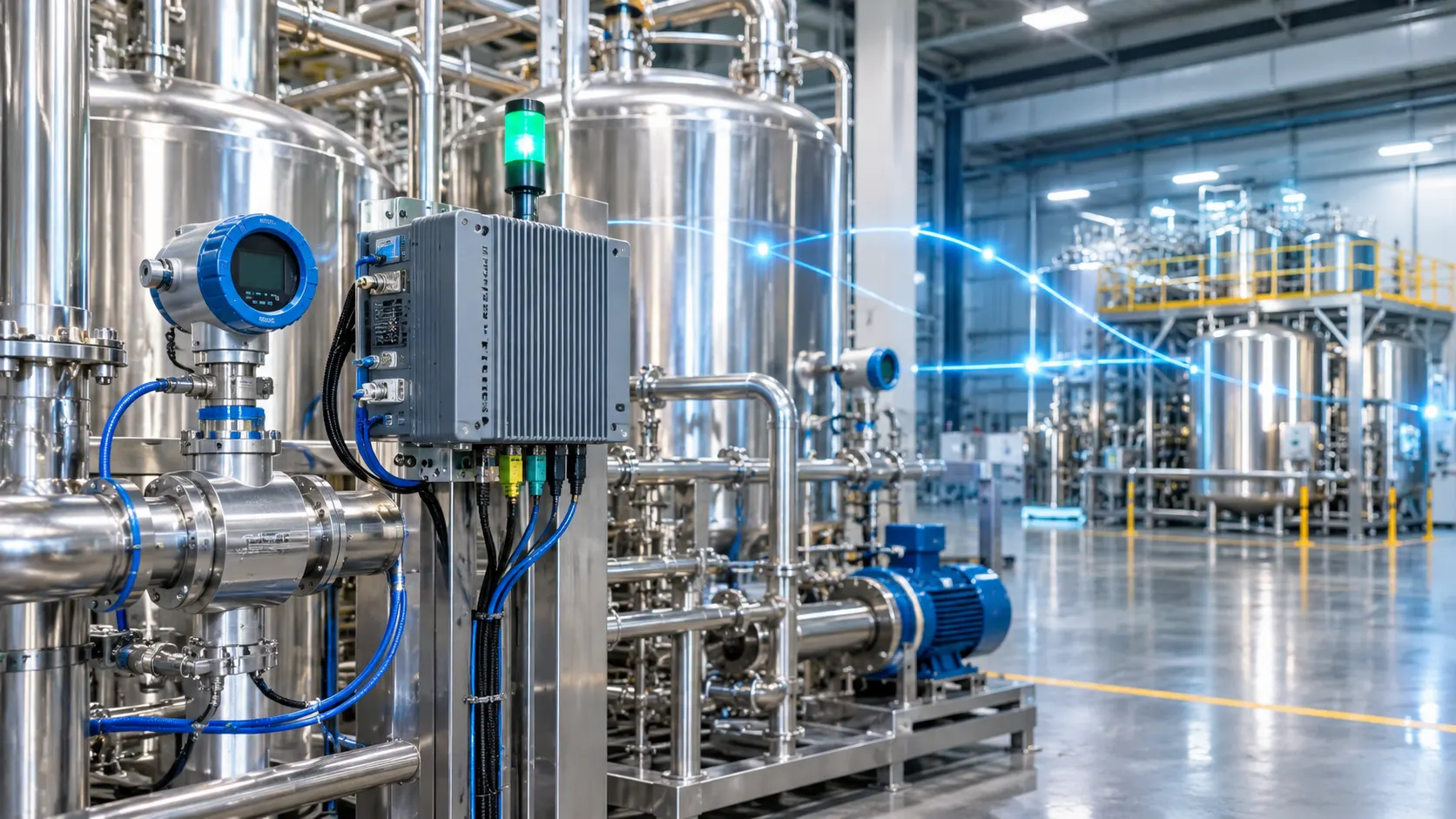
Proposed Research Demonstration: Knowledge and Learning Across a Beverage Line
A proposed demonstration could examine a beverage packaging line with inconsistent equipment records, limited examples of confirmed defects, and process data distributed across automation and enterprise systems. The test environment might include a filler, capper, labeler, conveyor, inspection station, selected sensors, an edge gateway, and representative MES, historian, and maintenance records. The demonstration should use an isolated, authorized test environment or an approved site pilot with documented permissions.
The demonstration would proceed in controlled stages:
Inventory the selected equipment and records. Document asset identifiers, PLC tags, sensor channels, units, timestamps, production context, and maintenance references.
Create a baseline mapping using the existing local records and measure the time and error rate associated with reconciling equipment information.
Develop a shared asset and semantic representation for the selected equipment, then compare mapping effort, missing relationships, and data interpretation errors.
Select a bounded learning task, such as classifying a defined packaging defect or identifying an abnormal equipment condition. Establish a local baseline using the available labeled examples.
Introduce reviewed expert feedback and a controlled adaptation method. Hold out selected equipment, production runs, or a second site to test generalization.
Monitor the candidate model through a staged release process. Record model version, approval, test results, deployment status, observed regressions, and rollback behavior.
Compare local and cross-site methods only where data rights and security approvals permit. Document what information is shared and what remains local.
Calculate complete pilot costs and compare predicted benefits with observed results over a defined measurement period.
This is a proposed research demonstration, not a statement that the demonstration has been completed or that a production-ready system is available. Scope, data access, equipment interfaces, and site authorization must be established before testing.
Evaluation Measures and Evidence Requirements
Evaluation should use reproducible test cases, documented baselines, and independently checked outcomes. Measures should be selected for the workflow rather than reported as a generic model score.
Knowledge mapping effort: engineering hours required to reconcile asset records, tag names, units, and system relationships.
Mapping quality: incorrect associations, missing links, duplicate identities, unresolved fields, and semantic interpretation errors.
Task performance: precision, recall, false-alert rate, missed-condition rate, and performance by equipment, product, operating mode, and site.
Generalization: performance on unfamiliar lines, equipment variants, production runs, and facilities held out from model development.
Expert effort: hours required for labeling, review, disagreement resolution, and validation of adapted models.
Operational impact: task completion time, inspection effort, maintenance prioritization usefulness, and effects on the selected production workflow.
Model governance: regressions after adaptation, release approval completeness, rollback success, and time to restore an accepted model version.
Privacy and data governance: exposure of restricted information, compliance with defined data rights, access violations, and audit completeness.
Integration effort: engineering hours, interface changes, data latency, rejected records, and recovery from interrupted exchanges.
Economic evidence: implementation and recurring costs, measured benefits, predicted-versus-measured value, and uncertainty ranges.
Results should be reported with test conditions, sample sizes, asset and site coverage, baseline definitions, known limitations, and the date of evaluation. A single aggregate score can hide failure on a particular product format, line speed, equipment type, or operating mode.
Limitations, Governance, and Research Status
Industrial learning is constrained by data quality, sparse fault examples, inconsistent naming, changing production conditions, and differences among facilities. A model trained on one beverage line may not transfer to another line with different sensors, controls, filler design, product characteristics, or maintenance practices. Synthetic data and augmentation can support testing, but they do not replace representative physical evidence.
Operator feedback can be incomplete or inconsistent, and intervention records may contain sensitive operational or workforce information. Data collection must follow defined access rights, retention policies, security controls, and applicable privacy requirements. Federated learning should be assessed as one possible architecture, not as a substitute for privacy engineering or governance.
Model updates must remain subject to review, testing, controlled release, monitoring, and rollback. AI-generated recommendations must not bypass established process controls, equipment protections, or authorized operating procedures. Any connection to physical action requires site-specific engineering and validation.
The topics on this page are research directions and proposed methods. The source brief does not establish completed BeveragePro demonstrations, measured performance improvements, production deployments, or guaranteed economic outcomes. Company-specific staffing, customer results, product availability, and implementation claims require separate verification before publication.
Related Research and Technical Resources
Explore related research and implementation guidance. Link only to pages that have been approved and published.
Research hub: Physical AI and AIoT Research for Beverage Production
→
Identification, Sensing, and State Estimation Research
→
Distributed Intelligence, Robotics, and Physical Logistics Research
→
Equipment Health, Inspection, and Quality Intelligence Research
→
Verified AI Decisions and Physical Control Research
→
Verification, Human Oversight, and Emerging Connectivity Research
→
Industrial Digital Twins and Simulation Research
→
Cybersecurity, Physical Security, and Trusted Industrial AI Research
→
AI Software and Analytics for Beverage Production
→
IoT Software for Beverage Production
→
System Integration and Deployment for Beverage Production
→
Integrating Physical AI and AIoT with Industry Systems
→
Designing and Evaluating a Physical AI or AIoT Pilot
→
Discuss a Beverage Production Research or Deployment Question
If your team is evaluating industrial knowledge integration, limited-data learning, model monitoring, or multi-site deployment, share the production workflow, equipment involved, available data sources, and the operational question you need to answer. A technical discussion can help identify the information, interfaces, and evaluation criteria needed to scope a responsible next step.
Cross-Site Model Monitoring and Beverage Plant Deployment
Deployment research must account for the equipment and information infrastructure that keeps a beverage facility operating. Edge gateways, industrial networks, sensor interfaces, process historians, and enterprise applications may have different ownership and maintenance responsibilities. A cross-site approach should define which functions run locally, which records may be exchanged, how model versions are synchronized, and what happens when connectivity is interrupted.
The proposed research compares local baselines with shared interfaces and reviewed adaptation across facilities. It should identify the costs and risks of transferring models between plants, including differences in process equipment, instrumentation, production schedules, data definitions, and local procedures. The objective is not uniformity for its own sake. It is a repeatable method for determining what can be reused, what must be adapted, and what requires new validation.
Discuss an industrial knowledge, AI learning, or deployment research question with BeveragePro
Share the equipment, process data, operating constraints, and outcomes your team needs to evaluate.