
Finished beverage pallets move between equipment and teams that may use different systems or procedures. A palletizer can create the physical load, a conveyor or forklift can transfer it to a warehouse zone, a warehouse operator can assign it to an order, and a shipping team can stage it for loading. If a scan is missed, a pallet is placed in an unexpected lane, or a transfer is recorded against the wrong load, inventory systems may show a location or status that no longer reflects the floor.
Beverage Pallet Movement and Handover
In a beverage plant, a finished-goods pallet may pass through several operational teams before it leaves the facility. It can move from the packaging line to a pallet buffer, finished-goods storage, an order-staging lane, and finally an outbound loading dock. Each transfer creates an opportunity for the physical pallet location and the warehouse or production record to fall out of sync. BeveragePro examines how Physical AI and the Artificial Intelligence of Things (AIoT) can connect pallet identity, movement observations, and handover records across these operating points.
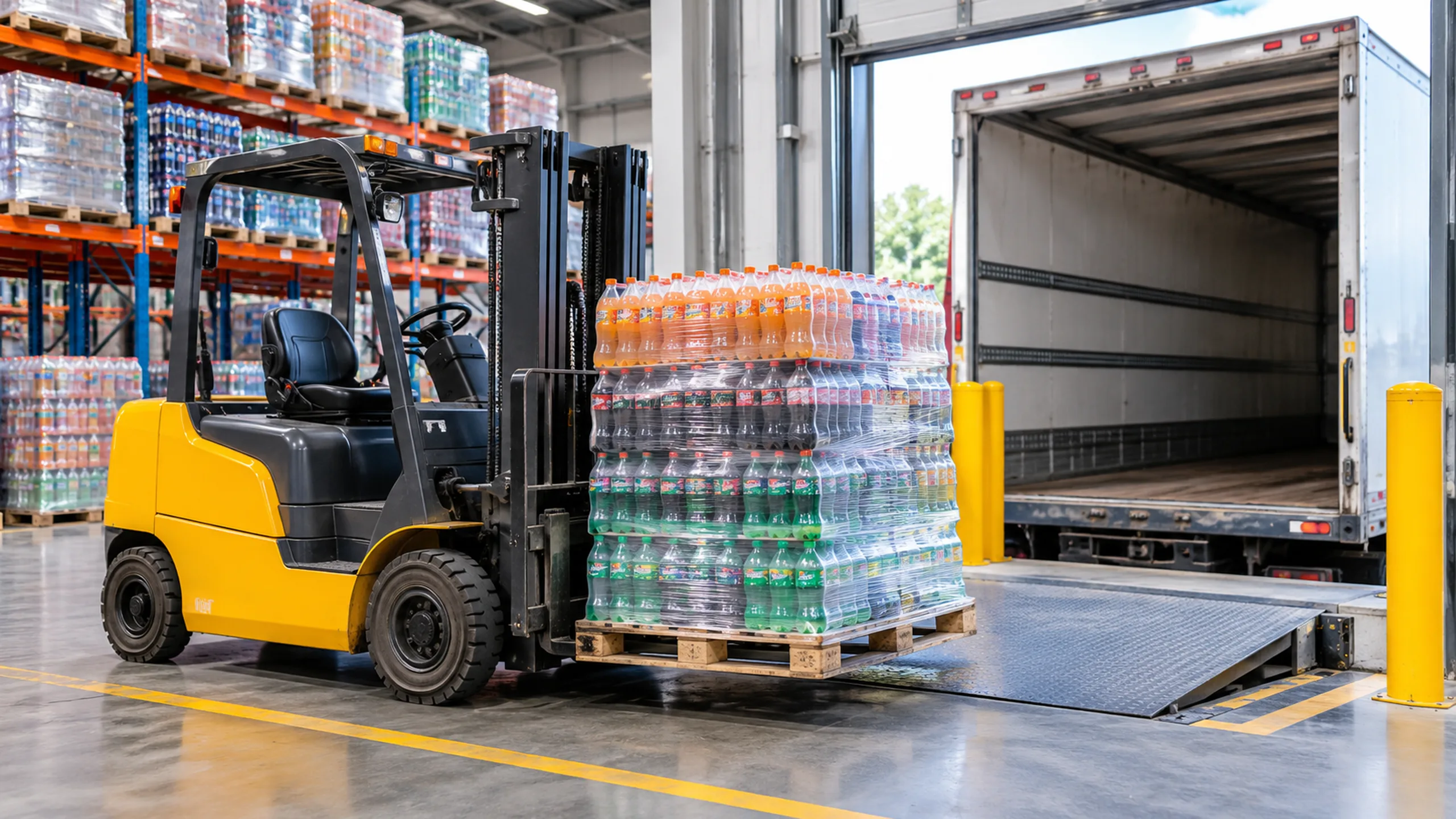
This illustrative application follows a pallet of packaged beverages from the end of a bottling line to an outbound trailer. The objective is not simply to show where a pallet was last detected. It is to create a time-stamped sequence of movement and receipt events that authorized operations personnel can review against production, inventory, and shipping records.
Where Beverage Pallet Handover Gaps Occur
The application is relevant to palletized finished goods such as bottled water, carbonated soft drinks, juice, sports drinks, and other packaged beverages. The exact identification method and event points depend on the packaging format, pallet type, facility layout, handling equipment, and existing warehouse procedures.
A Traceable Workflow from Packaging Line to Loading Dock
1. Pallet creation and arrival
At the end of the packaging line, the palletizer or stretch wrapper completes a load. A pallet identifier is associated with the relevant production order, product or stock-keeping unit (SKU), packaging format, quantity, and available lot or batch information. A barcode label, radio-frequency identification (RFID) tag, or another approved identifier can provide the reference used at downstream transfer points. The event record should distinguish pallet identity from the product and lot information carried by that pallet.
2. Identification at transfer points
A fixed reader zone, handheld scanner, or appropriately positioned vision system can capture an observation as the pallet passes a defined point. For example, a read zone may be placed between the packaging area and finished-goods storage, while a second capture point may be used at order staging. The selected method must be tested against pallet orientation, label placement, shrink-wrap, nearby metal, liquid containers, reader range, line speed, and the possibility of adjacent pallets being detected together.
3. Handover between production and warehouse teams
The transfer record can associate the pallet identifier with the sending area, receiving area, event time, relevant order or work reference, and the system or device that captured the observation. Where the process requires a person to accept custody, the workflow can include an operator confirmation or a scan at the receiving point. An automated read is evidence that an identifier was observed in a zone; it should not automatically be treated as proof that a named employee accepted responsibility.
4. Destination confirmation
A subsequent observation at the assigned storage lane or staging location helps confirm that the pallet reached its intended destination. If the expected destination event does not appear within the facility's defined time window, the system can flag the transfer for review. A supervisor or warehouse operator can compare the latest observation with the warehouse management system (WMS), forklift activity, order status, and a physical check before correcting the record.
5. Outbound staging and loading
Before loading, the pallet identifier can be checked against the shipment or load plan. A scan or reader event at the dock can record that the pallet entered the outbound area; a further confirmation can associate it with the trailer or shipment reference. The loading record should distinguish a pallet staged at the dock from one physically loaded and accepted for dispatch. Where loading confirmation is manual, the operator's confirmation and the system-generated observation should remain separately identifiable.
Identification, Sensing, and Connectivity Options
No single identification technology is suitable for every beverage facility. Selection should begin with the event the operation needs to prove, the required level of location detail, and the physical conditions at the capture point.
Barcode labels and handheld scanners can support deliberate pallet identification at packaging, staging, and loading checkpoints. They depend on label quality, line of sight, and consistent scanning procedures.
Passive RFID can support automatic identification at defined portal or conveyor read zones when tag placement, reader configuration, and the surrounding materials permit reliable reads.
Bluetooth Low Energy (BLE) or Ultra-Wideband (UWB) may be considered when the workflow requires location information beyond a simple checkpoint event. Infrastructure, battery management, site geometry, and required location resolution affect suitability.
Industrial gateways and edge devices can collect reader and sensor events, apply local filtering, preserve timestamps, and forward validated records to connected applications.
Photoelectric sensors, conveyor signals, or equipment status inputs can add context about a pallet's passage through a transfer point. These signals do not independently establish pallet identity unless they are correctly associated with an identifier.
The identification layer should preserve the original observation, the reader or device identity, the timestamp, and the zone or checkpoint. If multiple devices observe the same pallet, event processing can group related observations while retaining the source records for audit and troubleshooting.
How AIoT and Physical AI Support the Handover Record
The AIoT workflow connects identification devices, sensing inputs, edge processing, and operational software. It can normalize events from readers and scanners, associate them with pallet and order records, and make movement history available to authorized users. An AI decision function may help identify unusual event sequences, such as a pallet observed at an unexpected zone, a destination event that is missing, or two records that appear to conflict. These outputs should be presented as exceptions for review unless a validated process explicitly authorizes a further response.
Physical AI extends the information flow toward physical operations when suitable equipment interfaces and safeguards are available. In this application, the immediate priority is reliable movement visibility and verified handover, not autonomous control of forklifts or production machinery. Any future physical action, such as routing a pallet through an automated conveyor diverter, would require a separately defined equipment interface, operating limits, permissions, protective functions, and confirmation of the resulting physical state.
Exception Handling and Record Reconciliation
Beverage facilities should plan for imperfect observations rather than assume every scan or reader event will be captured correctly. Exception handling should preserve uncertainty and provide a clear route for human resolution.
Missed observation: the expected checkpoint event is absent. The system flags the transfer for a physical check or a new scan rather than inventing a location.
Incorrect association: a reader captures a nearby pallet or an identifier is linked to the wrong order. The event is held for comparison with the pallet label, production record, and shipment reference.
Duplicate event: repeated reads occur as a pallet pauses or moves within a read zone. Event logic can identify likely duplicates while retaining the underlying observations.
Out-of-sequence movement: a pallet appears at a destination before a corresponding dispatch event. The system marks the sequence as unresolved until the movement history is checked.
Delayed connectivity: a gateway or network connection is unavailable. Edge buffering can preserve locally captured events for later synchronization, with the original event time distinguished from the upload time.
Physical discrepancy: the digital record indicates receipt, but the pallet cannot be found at the assigned lane. The receiving team investigates the discrepancy and records the correction, reason, and responsible role.
Reconciliation should not silently overwrite the event history. A corrected location or shipment association should be stored as a new, attributable record linked to the original observation. Role-based access, retention rules, and audit logs help protect inventory data and make later investigation possible.
Integration with Beverage Production and Warehouse Systems
A movement workflow is useful only when its events can be interpreted by the systems that manage production, inventory, and shipping. Depending on the facility, relevant integrations may include a manufacturing execution system (MES), enterprise resource planning (ERP) platform, warehouse management system (WMS), transportation management system (TMS), production line controls, and shipping or dock applications.
The integration design should define the identifiers and event fields exchanged by each system. At a minimum, a movement event may include pallet ID, product or SKU, lot or batch reference where available, source zone, destination zone, event type, event timestamp, device or reader ID, order or shipment reference, and event-quality status. Facilities should also define how the workflow handles unknown identifiers, delayed messages, duplicate submissions, rejected records, and corrections.
Evaluating a Beverage Pallet Handover Application
A pilot should cover representative beverage formats, pallet configurations, traffic patterns, and operating shifts. Establish a baseline before deployment and compare the system's event history with physical checks and existing warehouse records. Evaluation should include normal movement as well as missed reads, adjacent pallets, unexpected routes, temporary network loss, and manual correction.
Event completeness: the proportion of expected pallet transfer events captured and correctly associated.
False-event rate: the frequency of observations incorrectly assigned to a pallet, zone, order, or shipment.
Handover delay: elapsed time between the recorded dispatch from one area and confirmed receipt in the next area.
Reconciliation time: the time warehouse and production personnel spend investigating and correcting movement discrepancies.
Receipt evidence: the proportion of handovers with a destination observation or documented operator confirmation.
Operational effort: scanning time, exception workload, device maintenance, label replacement, and support effort.
Acceptance thresholds should be agreed with production, warehouse, IT, and shipping stakeholders before the pilot begins. Results should be reported by checkpoint and operating condition so that strong performance in one area does not conceal gaps elsewhere. No accuracy, labor-saving, or throughput improvement should be assumed before it has been measured in the target facility.
A Practical Starting Point for Beverage Manufacturers
Begin with one finished-goods movement path, such as the transfer from a packaging line to a defined warehouse zone. Map the current handover steps, identify the records created at each step, and document where discrepancies occur. Then select the smallest set of identifiers, readers, gateways, and system interfaces needed to test the workflow under normal production conditions.
BeveragePro's Physical AI and AIoT approach provides a framework for evaluating identification, sensing, decision support, and appropriate physical action in beverage operations. The specific hardware, integrations, deployment arrangement, and maturity of each capability must be confirmed against the facility's requirements before implementation.
Discuss a beverage pallet traceability workflow with BeveragePro.