
Consider a beverage facility that wants to monitor product temperature at a pasteurizer outlet. The operational question is whether the temperature measurement is reliable enough to support process monitoring, trend analysis, and an operator review when readings move outside the site's approved operating limits. The example is illustrative; actual limits, sensor specifications, and control requirements must come from the facility's validated process and engineering documentation.
Selecting Sensors for Beverage Production
Selecting sensors for a beverage production facility starts with the physical condition the operation needs to measure. A temperature transmitter on a pasteurizer, a flow meter on a product line, a pressure sensor on a compressed-air header, and a photoelectric sensor at a bottle conveyor serve different purposes and operate under different conditions. The right choice depends on the measurement, the process, the installation point, and the decision that will use the reading.
For engineers, maintenance leaders, controls specialists, quality teams, and plant managers, sensor selection is not simply a matter of comparing catalog specifications. The instrument must produce dependable data in the actual production environment, withstand cleaning and operating conditions, connect to the control or data system, and remain practical to inspect and maintain. In Physical AI and Artificial Intelligence of Things (AIoT) applications, those requirements also determine whether edge devices and analytics receive measurements that are suitable for operational decisions.
1. Define the Measurement Requirement Before Choosing a Sensor
Begin by describing the process question in measurable terms. Identify the variable, its engineering units, the expected operating range, the required measurement uncertainty, and how quickly the value must be available. Include normal operation, startup, shutdown, cleaning, changeovers, and credible abnormal conditions. A sensor selected only for the normal production setpoint may saturate or become unreliable during a cleaning cycle or process upset.
Temperature in blending vessels, storage tanks, heat exchangers, pasteurizers, fillers, and cold rooms.
Pressure and differential pressure in product lines, filtration skids, pumps, compressed-air systems, and utility headers.
Flow and totalized volume for water, ingredients, cleaning solutions, product transfer, and filling operations.
Level in ingredient tanks, syrup vessels, water storage, fermentation vessels, and chemical supply containers.
pH and conductivity for product formulation, water treatment, cleaning-in-place (CIP) verification, and process monitoring where applicable.
Vibration, motor current, and bearing temperature on pumps, compressors, conveyors, mixers, and other rotating equipment.
Presence, position, and count at conveyors, bottle handling stations, case packers, and palletizing cells.
Environmental conditions such as humidity, ambient temperature, and air quality in storage, packaging, and production areas.
Specify the required response time and sampling interval as well. A slow-changing tank temperature may not need the same update rate as a high-speed bottle detection point. For a control loop, consider response time, repeatability, and compatibility with the control system. For condition monitoring, consider whether the sampling method captures the vibration or transient behavior associated with the fault being investigated.
Separate accuracy, repeatability, resolution, and response time. Accuracy describes closeness to a reference; repeatability describes consistency under the same conditions; resolution describes the smallest displayed or transmitted increment; and response time describes how quickly the instrument reflects a change. A high-resolution display does not, by itself, establish measurement accuracy.
2. Match Sensor Technology to the Process and Installation
The measurement point often determines the instrument design more strongly than the process name. Review the product or utility in contact with the sensor, process temperature and pressure, pipe size, flow profile, vibration, ambient conditions, and available mounting space. Confirm wetted-material compatibility with the beverage, ingredients, cleaning chemicals, and expected sanitation procedures. Where the instrument is exposed to washdown, moisture, dust, or corrosive cleaning agents, verify the enclosure and connector ratings against the actual exposure.
Mounting and process connection: confirm insertion depth, thermowell or fitting design, pipe orientation, nozzle location, and access for removal.
Hygienic design: assess cleanability, dead-leg risk, surface finish, seals, and compatibility with the facility's hygienic design requirements.
Measurement interference: consider pipe vibration, electrical noise, electromagnetic fields, bubbles, foam, turbulence, product buildup, and nearby equipment.
Power and wiring: check available supply voltage, cable routing, grounding, isolation, connector type, and hazardous-area requirements where relevant.
Communications: confirm required analog or digital signals, fieldbus or Industrial Ethernet compatibility, protocol support, gateway needs, and data access rights.
Serviceability: plan calibration access, cleaning, replacement, spare parts, and safe maintenance without unnecessary production disruption.
For example, a flow meter on a beverage transfer line must be evaluated for the liquid's conductivity, viscosity, temperature, flow profile, pipe configuration, and cleaning regime. A technology that is suitable for conductive liquids may not be appropriate for a low-conductivity product or a utility gas line. The instrument's installation requirements and manufacturer guidance should be reviewed for the specific service.
Do not assume that a sensor is suitable for food or beverage service because its housing is stainless steel. Review the complete wetted assembly, seals, process connections, cleanability, and applicable certifications or declarations. Confirm requirements with the plant's engineering, quality, and sanitation teams.
3. Design for Calibration, Drift, and Data Quality
A sensor reading should be treated as a measurement with context, not as an unquestioned fact. Calibration establishes the relationship between the instrument's output and a suitable reference. The calibration method, reference standard, tolerance, interval, and recordkeeping should reflect the process risk, instrument specification, site procedures, and applicable quality requirements.
Calibration error: readings may be biased if the instrument or reference is out of tolerance.
Drift: sensor output can change over time because of aging, fouling, wear, contamination, or exposure to process conditions.
Missing or interrupted readings: wiring faults, power loss, network interruptions, maintenance, and device resets can create gaps.
Outliers and spikes: electrical interference, process transients, bubbles, vibration, or communication faults can produce implausible values.
Stale data: a dashboard or analytics service may display an old value if timestamps or device-health status are not checked.
Incorrect context: a valid reading can be misleading if it is associated with the wrong asset, line, batch, operating mode, or engineering unit.
Record the sensor identifier, asset tag, location, measurement range, units, calibration status, timestamp, operating mode, and quality flag with the reading where the system design allows. Preserve the distinction between a measured value and a value inferred by an analytics model. AI-based anomaly detection can help identify unusual patterns, but it cannot correct an unsuitable sensor installation or replace calibration and engineering review.
For AIoT and Physical AI systems, make sensor health visible to the edge device, historian, dashboard, or analytics service. Define how the application behaves when a measurement is missing, stale, out of range, or marked invalid. A decision workflow should not silently treat a failed instrument as a normal process condition.
4. Beverage Production Example: Monitoring a Pasteurizer Temperature
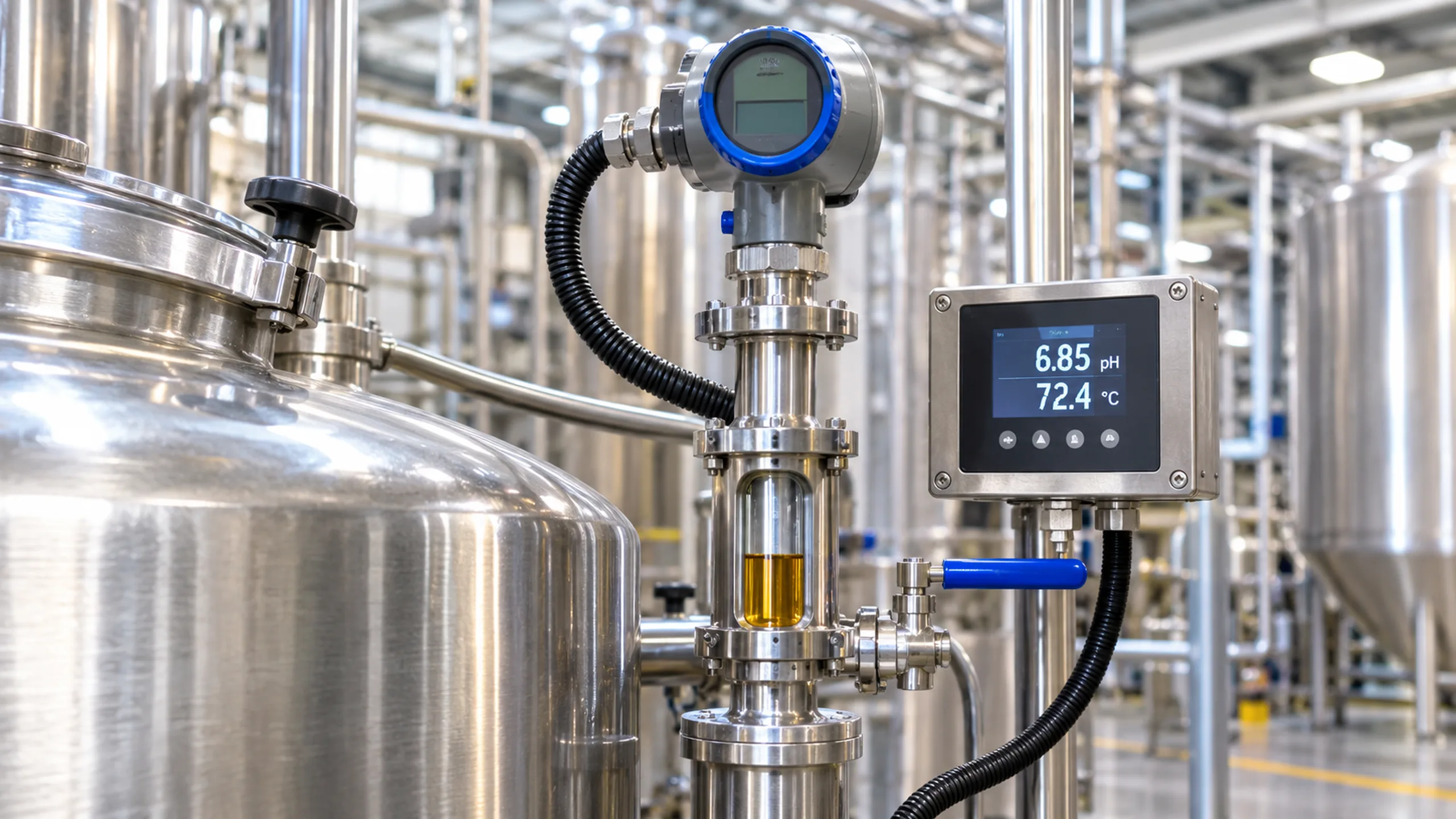
A temperature measurement point should be selected with the process engineer and controls team. They should confirm the measurement range, required uncertainty, response time, product-contact requirements, thermowell or direct-insertion arrangement, flow conditions, and the effects of cleaning cycles. The sensor and transmitter must be suitable for the operating temperature and pressure and compatible with the process connection and cleaning procedure.
A resistance temperature detector (RTD) may be considered where the required range and accuracy support its use. A thermocouple may be considered where a wider temperature range or different response and installation characteristics are needed. The selection should be based on the complete measurement assembly, including the sensing element, thermowell, transmitter, wiring, input module, and calibration method.
The reading should be time-stamped and associated with the pasteurizer, measurement point, product or production run where appropriate, and operating state. A supervisory system or AIoT application can trend the measurement and flag missing, stale, or unusual readings. Any alarm or operational response must follow the facility's approved process, quality, and safety procedures. Analytics should support, not replace, validated process controls or the responsible operator's authority.
A plausible alternative is to use a second measurement point for comparison or independent verification, if the process risk assessment and engineering design justify it. Additional sensors introduce installation, calibration, maintenance, and data-reconciliation requirements, so redundancy should be selected for a defined purpose rather than added by default.
5. Create an Acceptance Plan Before Installation
A sensor should be accepted against documented requirements under representative operating conditions. Define the test method and pass criteria before installation so the team can distinguish an instrument problem from a wiring, configuration, integration, or process issue.
Document the measurement point, process variable, engineering units, operating range, required uncertainty, response needs, and intended use.
Verify the instrument model, wetted materials, process connection, enclosure rating, power requirements, output type, communication protocol, and installation instructions.
Inspect mechanical installation, orientation, insertion depth, grounding, cable routing, connector sealing, and accessibility for cleaning and calibration.
Compare readings with an appropriate reference across the required operating range or representative test points. Record the reference, observed value, deviation, and acceptance decision.
Test normal operation and relevant transitions, including startup, shutdown, cleaning, changeover, and expected process variation.
Verify timestamps, units, asset association, signal scaling, quality flags, missing-data behavior, and alarm routing in the receiving control or data system.
Confirm that the sensor can be inspected, calibrated, removed, and replaced using the facility's maintenance procedures.
Assign ownership for calibration records, device configuration, data review, alarm response, and periodic performance checks.
Acceptance measures may include measurement deviation from a reference, repeatability, response time, data availability, missing-reading frequency, timestamp consistency, and maintenance effort. The appropriate thresholds depend on the process requirement and must be set by the responsible engineering and quality teams. Retain test results and configuration details so future troubleshooting and sensor replacement can be performed consistently.
6. Connect Sensor Data to the Wider Production System
A sensor becomes more useful when its readings can be interpreted alongside equipment identity, production context, and relevant operating records. Define how data will move from the instrument to an input/output (I/O) module, programmable logic controller (PLC), industrial gateway, edge computer, historian, manufacturing execution system (MES), or other approved application. Not every installation requires every component.
Agree on signal scaling, units, timestamps, sampling frequency, asset identifiers, data retention, access permissions, and responsibility for configuration changes. For digital devices, confirm the supported protocol, device description, diagnostics, and gateway compatibility. For analog signals, verify the electrical interface, scaling, isolation, and fault-state behavior. Test the complete path rather than assuming that a value displayed at the instrument will arrive correctly in downstream software.
For AIoT applications, edge processing can help validate readings, apply quality flags, and forward relevant events to local or remote services. AI analytics may then support trend analysis, anomaly detection, or maintenance prioritization. The design should identify what happens during network loss, server unavailability, or sensor failure, including whether data is buffered, whether alerts are delayed, and which functions remain local.
If a sensor reading can influence equipment action, define the authority and safeguards separately from the analytics. Recommendations, operator-approved commands, and bounded automated actions are different operating modes. Any physical control path requires validated interfaces, operating limits, appropriate protective functions, human oversight, and verification of the resulting equipment state.
7. Sensor Selection Checklist
What process variable must be measured, and what operational question will the reading answer?
What are the normal, transient, cleaning, and abnormal operating ranges?
What uncertainty, repeatability, resolution, and response time are required?
Are the wetted materials, seals, connections, and enclosure suitable for the process and sanitation environment?
Can the sensor be mounted in a representative location without unacceptable interference or maintenance difficulty?
What power, wiring, signal, protocol, gateway, and edge-processing requirements apply?
How will calibration, drift, missing data, outliers, timestamps, and sensor health be managed?
How will the reading be associated with the correct asset, line, batch, and operating mode?
What reference checks and operating tests will establish acceptance?
Who owns installation approval, calibration, configuration, data quality, alarm response, and periodic review?
Make Sensor Selection an Engineering Decision
The best sensor is the one that measures the required variable reliably in its intended location and provides data that the production team can interpret and maintain. Start with the process requirement, confirm the installation and hygienic constraints, define calibration and data-quality controls, and test the complete measurement path before relying on the readings.
BeveragePro applies a Physical AI and AIoT perspective to identification, sensing, data interpretation, and operational workflows in beverage production. To discuss a sensing requirement, equipment context, or integration question, contact the BeveragePro team through the Contact page.