
RFID is often a strong fit for identity checks and movement events at defined points, such as receiving lanes, pallet transfer points, wash areas, and shipping docks.
RFID vs. BLE vs. UWB for Beverage Production
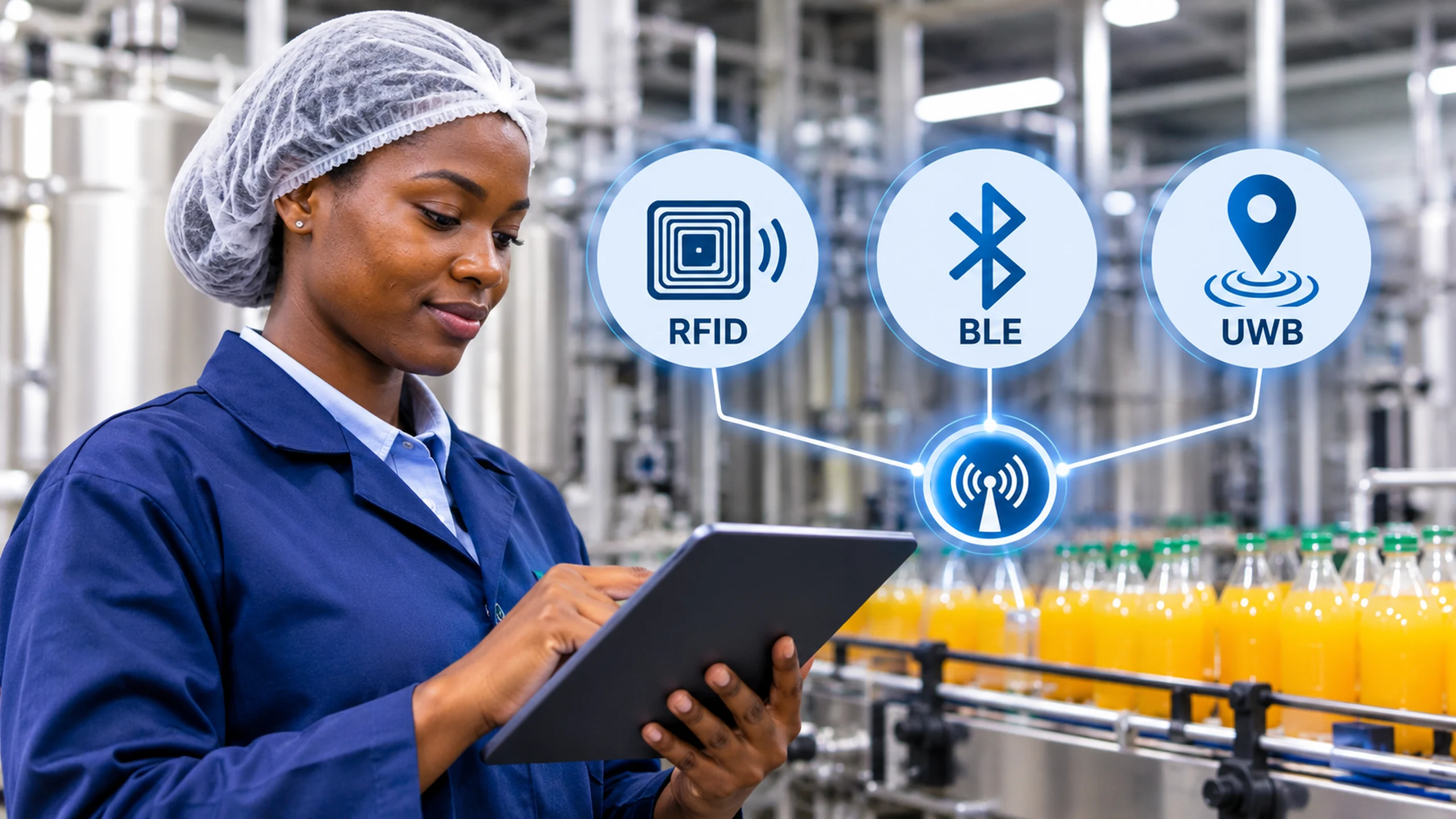
The right identification or location technology for a beverage production facility depends on what the operation needs to know, where observations must be captured, and how quickly that information must reach production, warehouse, and enterprise systems. Radio-frequency identification (RFID), Bluetooth Low Energy (BLE), and Ultra-Wideband (UWB) can all support asset visibility, but they solve different problems.
A beverage manufacturer may need to confirm that a pallet of finished product passed a dock door, locate a mobile ingredient tote inside a production building, or identify a reusable keg moving through a washing and filling process. These are not identical tracking tasks. Selecting a technology by its headline range or advertised accuracy alone can lead to missed reads, unnecessary infrastructure, or location data that does not answer the operational question.
For many facilities, the practical choice is not one technology for the entire plant. Passive RFID may suit repeatable identification points, BLE may provide broad zone-level visibility, and UWB may be appropriate where more precise real-time location is justified. A mixed architecture can combine these roles, provided that device identity, event timestamps, location confidence, and system integration are managed consistently.
Quick answer: which technology should a beverage plant choose?
Choose the technology according to the required output. If the operation needs to identify tagged cases, pallets, kegs, or containers as they pass a controlled read point, evaluate RFID. If the requirement is to estimate the zone or general location of powered mobile assets across a wider area, evaluate BLE beacon or tag positioning. If operators need more precise real-time location of forklifts, mobile ingredient tanks, or high-value production assets, evaluate UWB and validate its performance in the actual facility.
BLE is often considered for battery-powered tags and broad area or zone-level location, subject to beacon placement, receiver coverage, battery life, and the positioning method.
UWB is often considered when a workflow needs more precise real-time location, such as locating mobile equipment or tracking movement through congested production and warehouse areas.
A hybrid design can use RFID for item identity and handover confirmation, BLE for general asset visibility, and UWB for selected high-value or time-sensitive workflows.
Understand the three technologies
Radio-frequency identification (RFID)
RFID uses radio signals to exchange information between a tag and a reader. Passive RFID tags draw the energy needed for communication from the reader field and do not require an onboard battery. Active RFID tags use an internal power source and can transmit over greater distances or at configured intervals, depending on the system design. RFID implementations vary by frequency, tag construction, reader configuration, antenna placement, and the materials surrounding the tag.
In beverage production, passive RFID can support identification at controlled checkpoints. Examples include confirming pallet identity at a stretch-wrapper exit, recording reusable keg movement through a wash-and-fill workflow, or associating a tagged tote with a receiving or staging event. Active RFID may be considered for selected reusable assets where periodic identification or location reporting is required. Neither passive nor active RFID should be treated as a universal substitute for continuous, coordinate-based positioning.
Liquids, metal surfaces, dense product loads, and closely spaced tagged items can affect radio-frequency performance. Tag selection and mounting position matter. A tag designed for a cardboard case may not perform the same way when attached to a stainless-steel keg, a metal ingredient vessel, or a wet reusable container. The facility should test the intended tag on the actual asset and at the actual read point.
Bluetooth Low Energy (BLE)
BLE is a low-power wireless technology commonly used by battery-powered beacons and tags. A BLE tag can broadcast an identifier that nearby receivers detect. Depending on the design, the system may estimate proximity or a general zone from received signal strength, use multiple receivers for positioning, or combine BLE observations with other data sources. The result depends on receiver density, calibration, antenna placement, transmission settings, and the positioning algorithm.
For beverage manufacturers, BLE can be evaluated for zone-level visibility of mobile ingredient totes, maintenance carts, reusable containers, or selected warehouse assets. It can also support the visibility of powered equipment when a tag can be installed and maintained safely. BLE is not automatically a precise location system: a single receiver may indicate that a tag is nearby without establishing its exact position.
Battery replacement intervals, tag mounting, radio interference, metal obstructions, and changing production layouts should be included in the operating-cost assessment. A BLE deployment also needs a clear process for registering tags, replacing batteries, monitoring device health, and handling missing or stale observations.
Ultra-Wideband (UWB)
UWB is a short-range radio technology that can support precise ranging and real-time location when tags and fixed anchors are installed as a coordinated system. A typical deployment uses tags on tracked assets and anchors at surveyed positions. The system estimates location from signal timing or related ranging measurements, then provides position updates to an application or location service.
In a beverage plant, UWB may be evaluated for tracking forklifts, mobile tanks, high-value maintenance equipment, or other assets whose precise position affects dispatch, congestion management, or workflow coordination. It can be useful when knowing that an asset is somewhere in a large zone is not sufficient. The actual performance depends on anchor geometry, line of sight, multipath reflections, mounting height, obstruction, tag orientation, and calibration.
UWB typically requires more deliberate infrastructure planning than a simple RFID checkpoint or a small BLE beacon deployment. Anchors need suitable mounting locations, power and network connectivity, surveyed coordinates, and ongoing maintenance. The business case should therefore focus on workflows where better location information can produce a measurable operational benefit.
RFID vs. BLE vs. UWB: comparison for beverage manufacturing
The table below is a selection guide, not a performance guarantee. Actual range, accuracy, read reliability, update rate, and battery life depend on the selected equipment, installation, radio environment, and configuration. Obtain measured results from a representative site test before setting acceptance criteria.
| Evaluation factor | Passive RFID | Active RFID | BLE | UWB | Beverage plant consideration | Primary cost drivers |
|---|---|---|---|---|---|---|
| Primary role | Item or asset identification at a read point | Identification and periodic reporting from powered tags | Proximity or zone-level visibility; positioning with suitable receiver design | Ranging and real-time location using tags and anchors | Decide whether the process needs identity, a zone, or coordinates | Tags, readers or anchors, software, installation, integration |
| Tag power | No onboard battery | Battery or other internal power source | Usually battery-powered tag or beacon | Tag power requirements depend on selected hardware | Include battery service access and replacement workflow | Battery replacement, charging, tag lifecycle |
| Infrastructure | Readers and antennas at defined read zones | Readers or receivers matched to active tags | Beacons/tags and BLE receivers or gateways | Fixed anchors, tags, network and surveyed installation | Map doors, conveyors, staging lanes, tanks, racks and wash areas | Device count, cabling, mounting, network and commissioning |
| Location output | Read event at a configured point; not inherently continuous coordinates | Depends on system; may provide presence or location estimates | Proximity or estimated zone; precision varies by design | Estimated coordinates or location zones | Set the location granularity required by operators | Coverage density, calibration and software |
| Update behavior | When a tag enters a reader field and is successfully read | Configured transmission or interrogation behavior | Broadcast and scan intervals configured by the system | Configured ranging and location update rate | Match update frequency to asset speed and process timing | Air time, power use, network load and processing |
| Plant environment | Liquids, metal, wet surfaces and tag orientation can affect reads | Metal, liquid, obstructions and radio conditions can affect performance | Metal structures, interference and receiver placement affect signal estimates | Obstructions, reflections and anchor geometry affect ranging | Test on actual beverage containers, kegs, tanks, pallets and forklifts | Industrial-rated hardware, protective enclosures and maintenance |
| Best-fit examples | Pallet or keg identity at a checkpoint | Selected reusable assets requiring powered tags | General visibility of carts or mobile assets by area | Precise location of forklifts or mobile tanks | Choose by workflow rather than by technology trend | Total lifecycle cost and measurable process benefit |
How beverage production workflows influence the choice
Workflow 1: pallet, case, and finished-goods traceability
A finished-goods workflow may begin when packaged beverages leave the case packer or palletizer. The production or warehouse system needs to associate the pallet identifier with product, batch, packaging line, timestamp, and destination. A passive RFID tag on a reusable pallet or a label carrying an RFID inlay can be read at a defined transfer point, such as a conveyor crossing or dock portal. The read event can then be associated with the relevant manufacturing execution or warehouse record.
This workflow is primarily an identity and event-capture problem. RFID may be suitable when the facility can control the read zone and needs a reliable record that a tagged pallet passed a checkpoint. BLE may be useful when staff also need broader visibility of selected mobile assets between checkpoints. UWB may be unnecessary if the operation only needs confirmation at known transfer points.
The design must account for adjacent pallets, stacked loads, tag orientation, missed reads, duplicate reads, and the possibility that a pallet passes a reader without the expected business transaction. A read should not automatically be treated as proof of a completed shipment or customer handover. The event-processing layer should validate the identifier, timestamp, location, and transaction context.
Workflow 2: reusable kegs, ingredient totes, and mobile production assets
Reusable kegs and ingredient totes move through receiving, storage, preparation, production, washing, filling, and dispatch. Operators may need to know which asset is available, which area it occupies, and whether it has completed the required process stage. A tag can associate each asset with its maintenance, cleaning, inspection, and movement records.
RFID can record identity at controlled handover points, such as entry to a keg washer or movement into a filling area. BLE can provide general visibility of tagged assets across a larger production or warehouse zone. UWB can be evaluated where exact position is operationally important, for example when dispatching forklifts or locating mobile tanks in congested areas.
The material and cleaning conditions are important. Tags and mounting methods must tolerate the expected washdown, temperature, chemicals, vibration, and handling conditions. The tag must not interfere with cleaning, food-contact requirements, inspection, or safe operation. Confirm the required ingress protection and chemical compatibility with the equipment supplier and the facility's engineering and quality teams.
Infrastructure, power, and integration considerations
Map the facility before specifying readers, receivers, or anchors
Start with a current layout of the beverage plant, including filling and packaging lines, conveyor transfers, ingredient staging, cold rooms, warehouse aisles, dock doors, washdown areas, and maintenance zones. Mark where identity must be captured and where location must be estimated. A checkpoint-based workflow may need a small number of carefully positioned RFID readers. A zone-visibility workflow may need BLE receivers distributed across the relevant areas. A UWB design requires anchor placement and geometry to be assessed against walls, tanks, metal structures, racks, and moving equipment.
Do not assume that radio coverage is uniform across the building. Stainless-steel tanks, liquid-filled vessels, metal racks, forklifts, moving pallets, and people can alter signal paths. A commissioning plan should include normal production conditions, peak warehouse traffic, wet cleaning conditions where relevant, and realistic asset orientations.
Power and maintenance
Passive RFID reduces tag battery maintenance, but readers and network equipment still require power, connectivity, inspection, and configuration control.
Active RFID and BLE tags require a defined battery-life policy, device-health monitoring, replacement records, and a way to identify tags that stop reporting.
UWB tags and anchors require a maintenance plan that covers power, mounting integrity, anchor coordinates, network availability, and periodic performance checks.
All tag types need durable asset association, readable identifiers, replacement procedures, and controls that prevent an old tag from remaining assigned to the wrong asset.
Connect observations to beverage production systems
Identification and location data become operationally useful when they are associated with production and business records. Depending on the facility architecture, the receiving application may exchange data with a manufacturing execution system (MES), enterprise resource planning (ERP) platform, warehouse management system (WMS), computerized maintenance management system (CMMS), or supervisory control and data acquisition (SCADA) environment.
Define the event structure before deployment. A useful event record may include the tag identifier, asset identifier, event type, reader or anchor identifier, location zone, timestamp, confidence or quality indicator, and the related production order, batch, or transfer reference. Establish how the system handles missing observations, duplicate events, delayed messages, clock differences, invalid asset associations, and network outages.
An Internet of Things (IoT) gateway or edge device can collect observations locally, apply filtering and timestamp rules, and forward validated events to plant applications. Artificial Intelligence (AI) or Physical AI functions may use the resulting data to support asset-state estimation, exception detection, or workflow decisions. These functions should distinguish observed facts from inferred location or state. Tracking data alone does not authorize equipment movement or other physical action.
Evaluation checklist for a beverage plant pilot
A site pilot should test the selected technology on the actual assets, at the actual read points, and under representative production conditions. Establish the baseline and acceptance criteria before installation. Avoid relying on a vendor's maximum range or best-case accuracy as the sole evidence of suitability.
Define the operational question: identity at a checkpoint, zone-level visibility, or coordinate-based real-time location.
Select representative assets: bottles or cases where relevant, pallets, reusable kegs, ingredient totes, forklifts, mobile tanks, and maintenance carts.
Test actual materials and mounting positions, including metal surfaces, liquid-filled containers, stacked loads, and protective housings.
Map the radio environment across filling, packaging, warehouse, cold storage, washdown, and dock areas as applicable.
Measure event completeness: the proportion of expected asset passage or handover events captured correctly.
Measure false and duplicate events, missed reads, stale observations, and incorrect asset associations.
For location systems, compare estimated zones or coordinates with independently verified reference positions and report error by operating area.
Measure end-to-end latency from observation to availability in the production or warehouse application.
Record tag battery life or power behavior, device health, maintenance effort, and replacement frequency.
Test network interruption, recovery, event buffering, clock synchronization, and reconciliation of delayed observations.
Review installation cost, device count, integration effort, support requirements, and total cost of ownership.
Have production, warehouse, maintenance, IT, quality, and safety stakeholders review the results before expansion.
Common selection mistakes
Choosing a technology based only on advertised range or accuracy without testing the facility's metal structures, liquids, and production conditions.
Treating every RFID system as the same, without distinguishing passive and active tags, frequency bands, tag designs, and reader configurations.
Assuming BLE always provides exact coordinates when the implementation may only indicate proximity or a general zone.
Installing UWB anchors without surveying their positions or evaluating line-of-sight limitations and multipath reflections.
Ignoring tag attachment, washdown, cleaning chemicals, battery servicing, and asset lifecycle requirements.
Counting every radio observation as a confirmed business event without duplicate filtering, timestamp checks, and transaction validation.
Deploying tracking without defining data ownership, access permissions, retention, workforce privacy, and operational responsibilities.
Where Physical AI and AIoT fit
In a Physical AI and Artificial Intelligence of Things (AIoT) architecture, identification technologies provide observations about assets and movement. The identification function associates tags and read events with the correct pallet, keg, tote, vehicle, or piece of equipment. A sensing function can add temperature, vibration, pressure, or other condition measurements. AI-supported decision functions can then use identity, location, process context, and sensor data to help prioritize work or identify exceptions.
The practical value depends on data quality and system integration. A location estimate should carry its timestamp and quality status. A missing observation should remain distinguishable from an asset that is confirmed absent. Where a decision can lead to physical action, the command path requires authorization, defined operating limits, appropriate equipment interfaces, and confirmation of the resulting state.
BeveragePro's Physical AI and AIoT approach is intended to connect identification, sensing, AI-supported decisions, and, where appropriately integrated and authorized, physical action. Specific device compatibility, integrations, deployment options, and operational performance must be validated for each facility and project.
Frequently asked questions
Is RFID or BLE better for beverage production tracking?
Neither is universally better. RFID is often suited to identifying tagged assets at defined read points. BLE is often suited to broad visibility or zone-level positioning of powered tags. The correct choice depends on whether the workflow needs identity confirmation, proximity, or location information.
Can RFID track the exact location of a pallet inside a beverage warehouse?
A conventional RFID checkpoint system records a read event at a known reader location. It does not automatically provide continuous coordinates. More continuous location requires an appropriate active RFID or real-time location system design, and the result must be validated in the warehouse.
Does BLE provide real-time location tracking?
BLE can support location estimates when tags, receivers, and positioning software are designed for that purpose. Some deployments provide only proximity or zone-level information. Update frequency and location quality depend on tag settings, receiver placement, radio conditions, and the positioning method.
When should a beverage plant consider UWB?
Consider UWB when a defined workflow needs more precise real-time location than a checkpoint or zone-level system can provide. Potential examples include locating forklifts, mobile ingredient tanks, or high-value assets in busy production and warehouse areas. Confirm the expected benefit against anchor installation, calibration, integration, and maintenance costs.
Can a beverage manufacturer combine RFID, BLE, and UWB?
Yes. A facility can use RFID for identity and handover events, BLE for general visibility, and UWB for selected precise-location tasks. A hybrid system needs consistent asset identifiers, event processing, timestamps, data-quality rules, and integration with operational records.
Do metal tanks and liquid-filled containers affect RFID, BLE, or UWB?
They can affect radio performance, but the impact varies by frequency, tag and antenna design, mounting position, and the surrounding environment. Test the selected hardware on the actual tank, container, pallet, or equipment before finalizing the design.
What should be measured during an RFID, BLE, or UWB pilot?
Measure event completeness, missed and duplicate observations, false associations, location error where applicable, update latency, device availability, battery or power behavior, maintenance effort, integration reliability, and total deployment cost. Compare the results with a documented operational baseline.