
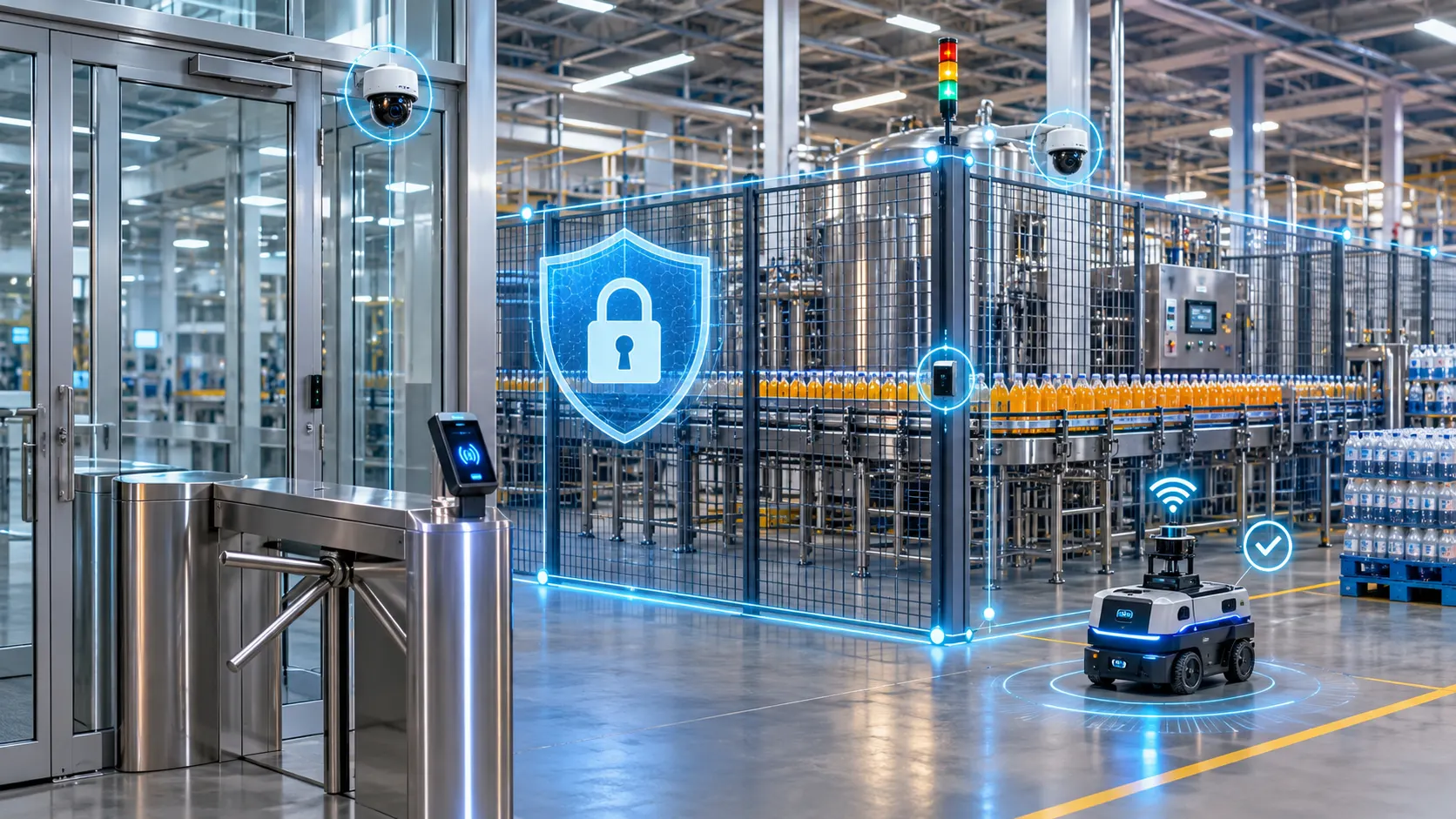
A beverage facility combines information technology (IT), OT, industrial control systems, sensors, machine vision, production data platforms, and increasingly capable AI-enabled equipment. A weakness in one layer can affect the reliability of another. A manipulated level or flow observation, an unauthorized control command, an exposed remote-access path, or a compromised software update can create consequences beyond data loss.
Cybersecurity, Physical Security and Trusted Industrial AI Research for Beverage Production
Connected beverage production systems depend on trustworthy observations and authorized actions. BeveragePro’s research direction examines how to protect devices, artificial intelligence (AI), command paths, mobile platforms, and physical assets while maintaining essential production operations. The focus includes bottling and filling lines, packaging equipment, conveyors, industrial sensors, operational technology (OT) networks, edge systems, and connected automation.
Why security must extend from the network to the production floor
Research therefore needs to consider both digital compromise and physical impact. Cybersecurity controls protect identities, communications, software, data, and command authority. Physical security protects facilities, production zones, equipment, and assets. Privacy governs the collection and use of information about people. Equipment safety addresses hazards and safe machine behavior. These disciplines are related, but they are not interchangeable.
Research areas for beverage production security
Device identity, onboarding, and lifecycle security
Investigate how industrial sensors, programmable logic controllers (PLCs), gateways, cameras, edge computers, and mobile platforms can be identified and managed throughout their operating lifecycles. Candidate questions include how devices are authenticated before joining a production network, how credentials are provisioned and rotated, how ownership and configuration changes are recorded, and how unsupported or retired devices are removed.
- Candidate methods: device certificates, hardware-backed identity where available, controlled onboarding, asset inventories, credential rotation, and lifecycle status records.
- Relevant evidence: identity coverage, onboarding errors, unauthorized-device rejection, credential exposure, and time required to revoke or replace a device identity.
OT network segmentation and restricted remote access
Examine network boundaries between production lines, packaging cells, plant supervisory systems, enterprise IT, cloud services, and external support connections. Consider whether communication is limited to documented business and control needs, whether remote sessions are authenticated and approved, and whether access can be suspended without disrupting essential operations.
- Candidate methods: zone-and-conduit design, allowlisted communication, monitored gateways, time-limited remote access, multifactor authentication, and auditable session controls.
- Relevant evidence: unauthorized path blocking, exposure of critical assets, access-policy violations, legitimate workflow impact, and response time when access must be withdrawn.
Sensor integrity, spoofing resistance, and trusted AI commands
Beverage production decisions may depend on observations such as fill level, flow, pressure, temperature, conveyor position, product presence, package condition, and machine state. Research can examine how the system detects manipulated, stale, inconsistent, or implausible observations before they influence AI recommendations or equipment actions.
- Candidate methods: cross-sensor consistency checks, plausibility bounds, timestamp and provenance validation, anomaly detection, confidence thresholds, and independent command authorization.
- Evaluate whether an AI agent or control service can issue only permitted commands, to approved equipment, within defined operating limits, and under the required human or supervisory authority.
Model, data, and software supply-chain integrity
Investigate the integrity of software, firmware, AI models, training and evaluation data, configuration files, and deployment packages used across beverage production systems. Consider how versions are identified, changes are reviewed, approved artifacts are distributed, and installations are verified or rolled back.
- Candidate methods: signed artifacts, provenance records, controlled repositories, dependency inventories, approval workflows, integrity checks, and rollback procedures.
- Relevant evidence: artifact verification success, unauthorized-change detection, deployment traceability, rollback reliability, and the effect of controls on approved maintenance.
Physical access, perimeter, and asset security
Explore how access to control rooms, electrical cabinets, network racks, line-side panels, production zones, server rooms, and mobile equipment can be restricted and monitored. Research may include badge or credential controls, visitor procedures, camera coverage, tamper detection, and asset inventories.
- Candidate methods: role-based access, controlled entry, monitored cabinets, tamper alerts, asset-location records, and documented response procedures.
- Do not imply that cameras or access-control equipment alone establish secure operations; evaluate the full operating process and response path.
Privacy in industrial sensing and workforce analytics
Industrial sensing and video analytics may incidentally collect information about operators, contractors, and visitors. Research should define the purpose and necessity of each data source, limit collection to the minimum needed, control access and retention, and assess whether a less intrusive method can meet the operational requirement.
- Candidate methods: data minimization, purpose limitation, role-based access, retention schedules, aggregation, de-identification where suitable, and privacy impact review.
- Workforce monitoring must not be presented as a default requirement for production security.
- Test shared-map integrity and the effect of incorrect or stale map data on routing and operational decisions.
- Assess secure update delivery, version verification, and rollback for mobile platforms and supporting fleet services.
- Define how operators can safely stop, isolate, inspect, recover, and return a platform to service.
Incident containment and recovery should include verified restart conditions. A system should not resume normal operation merely because connectivity has returned; identity, software, configuration, sensor state, and command authority should be checked according to the defined recovery procedure.
Proposed research demonstration
A proposed demonstration would use an isolated, authorized testbed with simulated beverage-production devices, command gateways, or mobile platforms. The test environment should not connect to live production controls unless a separate, documented authorization and safety review explicitly permits it.
Introduce manipulated or inconsistent sensor observations and assess whether they are detected or rejected.
Attempt commands with invalid, expired, or insufficient authority and verify that the command path blocks them.
Test a compromised or unverified software update and evaluate artifact verification, containment, and rollback.
Simulate a compromised fleet member or corrupted shared map and assess isolation and continued safe operation of unaffected assets.
Exercise incident recovery and verify restart prerequisites before restoring normal operation.
This is a proposed evaluation approach, not a statement that BeveragePro has completed these tests or achieved measured results.
Evaluation measures and evidence
Evaluation should compare security performance with the operational impact of the controls. Report test conditions, assumptions, baseline, limitations, and evidence gaps.
Residual unauthorized-action success: proportion of unauthorized attempts that still result in an accepted action.
Detection delay: elapsed time between a defined attack or fault condition and its detection.
False alarms: alerts raised during legitimate operating conditions.
Legitimate-task degradation: change in task completion, throughput, availability, or operator workload caused by security controls.
Recovery time: time required to contain an incident, verify system integrity, and restore an approved operating state.
Physical outcome checks: evidence that the test did not create an unsafe or unintended physical condition.
Cryptographic resource costs: processing, memory, latency, bandwidth, and lifecycle implications of cryptographic changes.
Where applicable, compare results against a documented baseline and include repeatability information. Do not publish numerical performance claims until supported by verified test evidence.
Cryptographic agility and post-quantum migration
Research can examine how beverage production environments can inventory cryptographic dependencies and prepare for future algorithm transitions. This includes device capabilities, certificates, secure communications, update mechanisms, gateways, and long-lived equipment that may be difficult to replace. Candidate work includes crypto-agility planning, compatibility testing, resource-cost measurement, and staged migration options. Do not claim a specific post-quantum deployment or compliance status without evidence.
How security supports Physical AI and AIoT
Security is a cross-cutting requirement for the identification, sensing, decision, and physical-action functions used in connected beverage production. Identification establishes which device, asset, or system is communicating. Sensing provides observations about equipment and production conditions. AI decision functions interpret information and propose actions. Physical action functions carry out authorized changes through machinery or mobile platforms. Security controls help protect the integrity and authority of each transition.
For Artificial Intelligence of Things (AIoT) deployments that monitor and analyze connected equipment, the focus may be on trusted device identity, sensing, data integrity, and controlled connectivity. For Physical AI deployments that can affect the physical environment, the scope also includes command authorization, physical safeguards, safe-state behavior, and verified recovery.
Research status, scope, and limitations
This page describes a research direction and candidate methods for beverage production. It does not establish that a specific study, deployment, testbed, partnership, product, certification, or measured outcome exists. Research proposals, demonstrations, active work, and published findings must be clearly distinguished as the program develops.
Cybersecurity testing is not equipment-safety certification. Physical security controls do not replace process safety or machine safeguarding. Privacy controls require context-specific review. Any demonstration involving operational equipment must have documented authorization, isolation boundaries, risk controls, and an approved recovery plan.
Related research and technical resources
Research hub
→
Cybersecurity and Physical Action Safeguards
→
Identification Engine
→
Physical AI Action Engine
→
IoT Software
→
System Integration and Deployment
→
Identification, Sensing, and State Estimation Research
→
Distributed Intelligence, Robots, Drones, and Autonomous Vehicles Research
→
Equipment Health, Inspection, and Quality Intelligence Research
→
Verified AI Decisions and Physical Control Research
→
Verification, Human Oversight, and Emerging Connectivity Research
→
Industrial Digital Twins and Simulation Research
→
Industrial Knowledge, Learning, and Deployment Research
→
Discuss a beverage production security research question
If your team is evaluating the security of connected beverage production equipment, OT networks, industrial sensing, AI-enabled decisions, or autonomous mobile platforms, contact BeveragePro to discuss the operating context and the evidence needed to assess a suitable research or integration question.